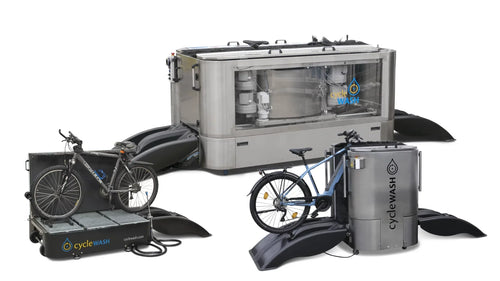
Self-service bike wash revenue typically beats attended models on margin, because the machine works without paid staff. Is a self-service bike wash profitable? Yes — for most operators it is the stronger format. A self-service station collects payment per wash, runs unattended through opening hours, and removes the single largest variable cost: labour. With a cycleWASH machine, typical payback lands in the 15–26 month range, after which the unit generates net revenue with only consumables and maintenance to cover. Attended washing earns a higher price per bike but rarely closes the gap once wages are counted.
How the two models earn
An attended bike wash charges a premium for a hand-finished service. A trained operator washes each bike, so throughput is limited by staff hours and the price must absorb a wage for every minute the station is open. Revenue scales with headcount, not footfall.
A self-service bike wash charges per cycle and runs on its own. The customer starts the machine, the wash completes, and the next customer follows. Revenue scales with location traffic and opening hours rather than with payroll. The same site can take payments at 7am and 9pm without anyone on shift.
Where self-service wins
The decisive factor is cost structure. Self-service removes the recurring wage line entirely, so almost all incremental revenue after fixed costs drops to margin. Three further advantages:
- Hours. The machine earns whenever the site is open — early mornings, late evenings, weekends — with no overtime.
- Consistency. A cycleWASH cycle delivers the same result every time. No variation by operator skill or fatigue.
- Scalability. Add a second or third unit without hiring. Each machine is an independent revenue point.
cycleWASH machines are Made in Germany, DEKRA/CE certified, and built on 35 granted IP rights. Over 350 units are in service across 24+ countries, having washed more than 1 million bikes in roughly ten years of operation. That track record matters when you are projecting revenue over a 15–26 month payback period.
Where attended still makes sense
Attended washing is not obsolete. It fits premium retail, events, and concierge settings where the service itself is the product and the customer expects a person. In those contexts the higher per-bike price is justified and labour is part of the offer, not a drag on it. For volume sites — dealers, fleet depots, campsites, municipal cycle hubs, e-bike retailers — self-service is the higher-earning default.
Running the numbers
Profitability comes down to wash volume against fixed cost. A self-service unit first earns back its purchase price, then covers consumables and maintenance, then turns the rest to profit. Entry pricing starts with the Mini Station at EUR 17,500, with Mini Basic at EUR 25,990 and Mini Platinum at EUR 29,990. The Pro range starts from EUR 45,000. Every machine is sold outright at the list price, ex works Cologne. Payment: online orders are paid in full at checkout; orders placed by quote or purchase order pay two-thirds with the order and the remaining third before delivery. With typical payback in 15–26 months, a modest daily wash count earns back the purchase price and still clears margin.
To model your own site, use the ROI calculator — enter expected wash volume and price per cycle to see your payback window. For a compact entry point, the Mini line is the most common starting machine for new self-service operators.
The verdict
For unattended, high-traffic locations, self-service earns more per euro invested because it strips out the wage cost that limits attended washing. Attended stays valid for premium and event work. Most operators evaluating revenue per square metre and per hour will land on self-service.
Ready to size your return? Start with the Mini range and run your figures through the ROI calculator.